Post-quantum Privacy Pass: anonymous credentials from UOV and VOLE-in-the-head
Originally published in pqc-research, where it is maintained. This page renders that document.
Privacy Pass lets a site rate-limit or vouch for a client without learning who it is: an issuer hands out tokens, and a token's redemption cannot be linked to its issuance. Today's tokens rest on RSA blind signatures and elliptic curves. On 6 November 2026 Cloudflare Research published three post-quantum replacements built from the UOV multivariate signature and the VOLE-in-the-head proof system behind FAEST, with an implementation. This note reads the post and the code. Post: https://blog.cloudflare.com/vole-mole/ (Bas Westerbaan). Code: https://github.com/cloudflareresearch/vole-mole.
The short version
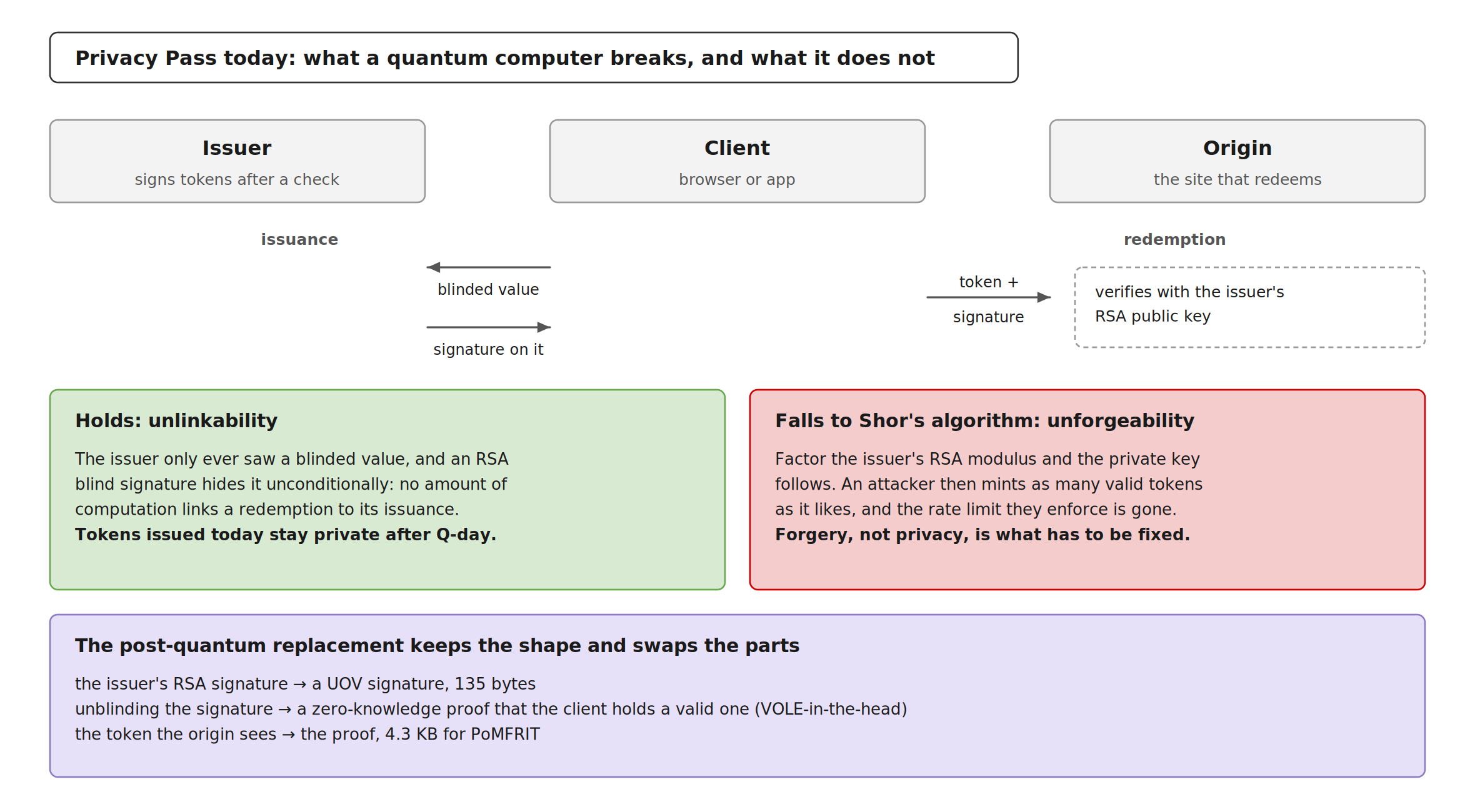
A quantum computer breaks forgery, not privacy. Privacy Pass is unconditionally private: once Q-day arrives, already-issued tokens stay unlinkable. What falls is the issuer's signature, so an attacker could mint tokens and walk past the rate limits they enforce.
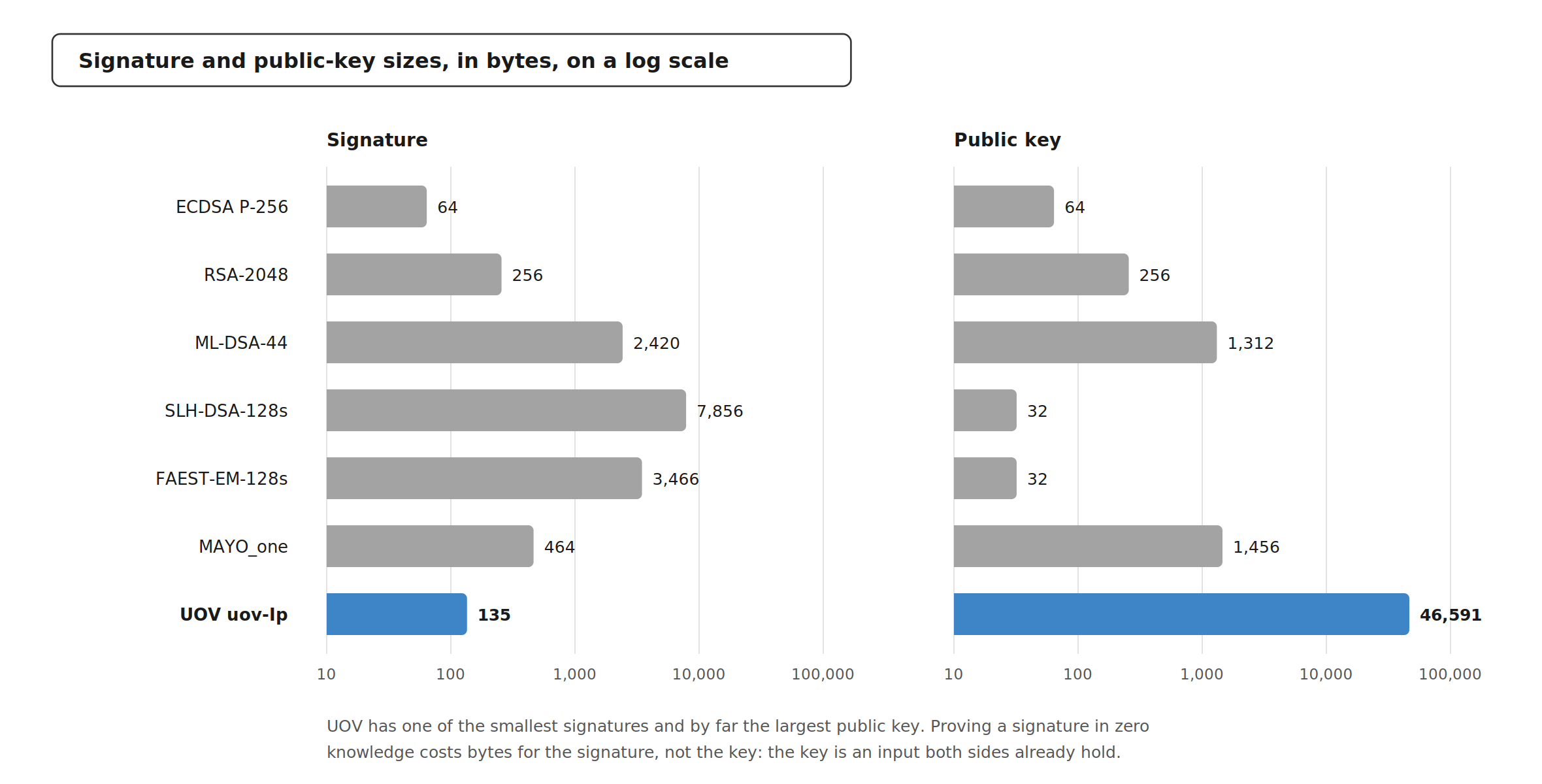
The building blocks are UOV and VOLE-in-the-head. UOV is a multivariate signature: 135-byte signatures, 46.6 KB public keys, and verification that is just 45 quadratic equations. VOLE-in-the-head, the proof system behind FAEST, proves degree-2 equations over binary fields cheaply, with proofs that grow with the witness. A UOV signature is a 952-bit witness for 45 such equations, so proving one is cheap. All estimates use FAEST-EM-128s parameters.
Three constructions cover the Privacy Pass family.
Scheme What it is Issuance Presentation PoMFRIT (with UOV) blind signature < 1 KB 4.3 KB VOLE-IHAT token that also hides which issuer signed it 5.6 KB 6.5 KB VOLE-ACT anonymous credit token with a hidden balance 5.4 KB 12.0 KB The cost is in line with the rest of the migration. The authors put the overhead of replacing RSA blind signatures with PoMFRIT on a par with replacing ECDSA with ML-DSA, and every operation runs in milliseconds.
It is research code. The repository describes itself as experimental and unaudited, with APIs and wire formats expected to change, and one of the optimisations rests on a new assumption, one-more-UOV.
1. What Privacy Pass protects
An issuer signs a token for a client after some check, such as a challenge or an attestation. Later the client presents the token to a site, which verifies the signature. Two properties matter:
- Unlinkability. The issuer cannot tell which issuance a redemption came from. RSA blind signatures give this unconditionally, so it holds against any attacker, quantum or not.
- Unforgeability. Only the issuer can make tokens. This rests on RSA, and Shor's algorithm breaks it.
The post also cites a recent classical result: researchers at UC San Diego and Inria forged a 1024-bit RSA signature by using a Privacy Pass issuer as a signing oracle (ePrint 2026/2131). Privacy Pass deployments use 2048-bit RSA, which the authors consider a comfortable margin with the other defences in place.
The tokens also reveal their issuer, because verification needs the issuer's public key. Hiding that is what VOLE-IHAT adds.
2. UOV, the signature
The hard problem
UOV belongs to multivariate public-key cryptography. Its public key is a map \(P\colon \mathbb{F}_q^n \to \mathbb{F}_q^m\) made of \(m\) quadratic polynomials in \(n\) variables,
\[p_k(x_1, \dots, x_n) = \sum_{i \le j} a^{(k)}_{ij}\, x_i x_j + \sum_{i} b^{(k)}_i\, x_i + c^{(k)}, \qquad k = 1, \dots, m\]
Evaluating \(P\) takes only multiplications and additions. Inverting it, which means finding some \(x\) with \(P(x) = t\), is the MQ problem. MQ is NP-complete over every finite field, and its hardest instances have \(m\) and \(n\) of the same order. Factoring and discrete logarithms play no part, which is why Shor's algorithm has nothing to attack.
The trapdoor: oil and vinegar
The signer knows a hidden structure that makes one particular \(P\) easy to invert. The variables are split into \(v = n - m\) vinegar variables and \(m\) oil variables, and each secret polynomial \(f_k\) is built with no oil-times-oil terms:
\[f_k(x) = \sum_{i \le v,\ j \ge i} \alpha^{(k)}_{ij}\, x_i x_j\]
Fix the vinegar variables to random values and every \(f_k\) becomes linear in the oil variables. Inverting \(F = (f_1, \dots, f_m)\) then means solving \(m\) linear equations in \(m\) unknowns by Gaussian elimination. If the system happens to be singular, the signer draws new vinegar values. A random invertible linear map \(T\) hides the structure, and the public key is \(P = F \circ T\). In geometric terms, the secret is an \(m\)-dimensional oil space on which \(P\) vanishes, and every attack on UOV is an attempt to find it.
Signing. Hash the message with a fresh 16-byte salt to a target \(t \in \mathbb{F}_q^m\), invert \(F\) as above to get \(u\), and output \(s = T^{-1}(u)\) with the salt. Verifying. Check \(P(s) = \mathrm{Hash}(\text{message} \parallel \text{salt})\): evaluate \(m\) quadratic polynomials and compare.
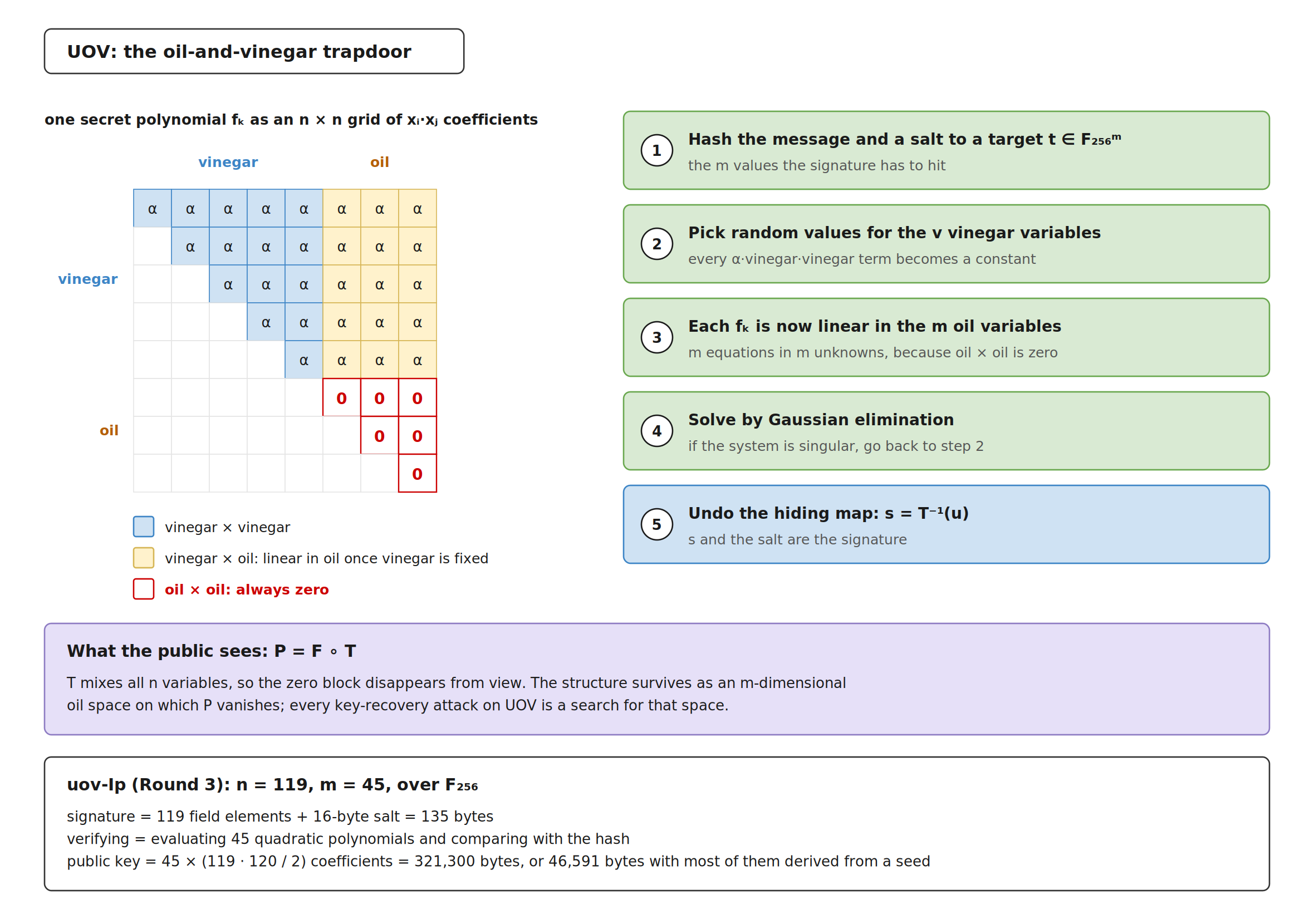
That shape explains UOV's sizes. The signature is just \(n\) field elements plus the salt, and the public key is every coefficient of \(P\). For uov-Ip, that is \(45 \times (119 \times 120 / 2) = 321{,}300\) bytes. The compressed variant, used here, derives most of the coefficients from a seed and stores the rest: 46,591 bytes.
| Round-3 parameter set | NIST level | (n, m, q) | Compressed public key | Signature |
|---|---|---|---|---|
| uov-Ip | 1 | (119, 45, 256) | 46,591 B | 135 B |
| uov-Is | 1 | (160, 64, 16) | 66,576 B | 96 B |
| uov-III | 3 | (193, 72, 256) | 189,232 B | 209 B |
| uov-V | 5 | (259, 96, 256) | 446,992 B | 275 B |
The Privacy Pass work uses uov-Ip, which is where its 135-byte signatures and 46.6 KB keys come from.
Three decades of cryptanalysis
- 1997. Patarin proposes Oil and Vinegar with as many vinegar as oil variables.
- 1998. Kipnis and Shamir break that balanced version with an invariant-subspace attack that recovers the oil space.
- 1999. Kipnis, Patarin and Goubin publish Unbalanced Oil and Vinegar, with \(n > 2m\), which puts the oil space out of that attack's reach.
- 2022. Beullens breaks Rainbow, a layered UOV variant and NIST round-3 finalist, in "a weekend on a laptop". The attack used Rainbow's extra layers, and plain UOV went on into NIST's additional-signatures process.
- 2025–2026. The wedge attack (Ran; generalised by Jin et al. and by Furue and Ikematsu) gives a new way to search for the oil space. UOV's Round 3 specification (30 August 2026) raised its parameters in response, moving uov-Ip to \(n = 119\), \(m = 45\).
The Round 3 specification puts the cheapest known attack on uov-Ip, the wedge attack, at \(2^{144}\) bit operations, and the direct algebraic attack at \(2^{146}\).
Relatives
UOV's weakness is the size of its public key, and its relatives trade structure for smaller keys.
- MAYO (Beullens) uses an oil space too small to sign with directly and "whips" it into a larger map: MAYO_one has a 1,456-byte public key and 464-byte signatures.
- QR-UOV and SNOVA compress the key with algebraic structure.
UOV, MAYO, QR-UOV and SNOVA are all in the third round of NIST's additional signatures (NIST IR 8610, May 2026).
3. VOLE-in-the-head, the proof system
VOLE as a commitment
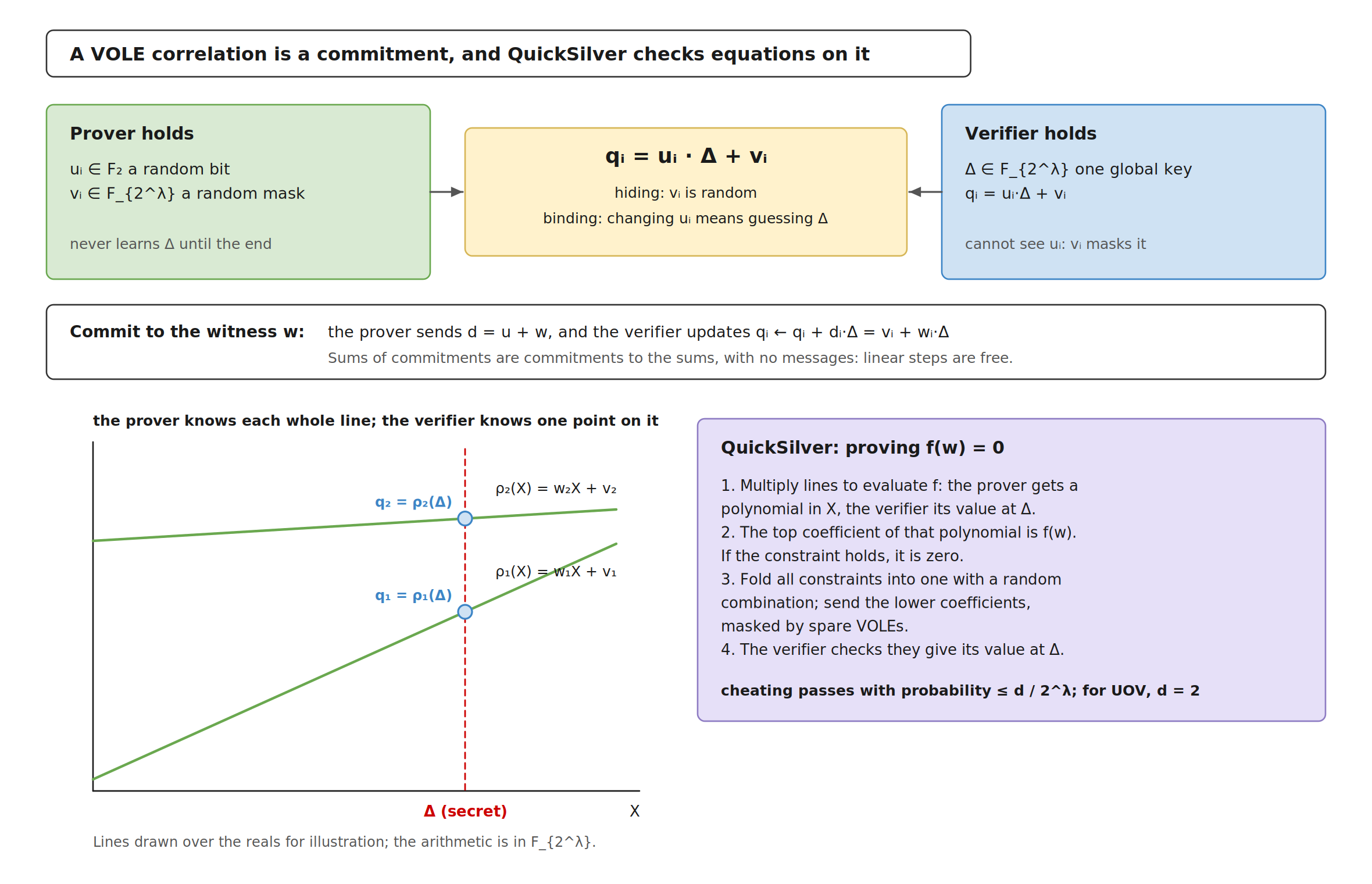
A VOLE correlation gives the prover random bits \(u_i \in \mathbb{F}_2\) and field elements \(v_i \in \mathbb{F}_{2^\lambda}\), and gives the verifier a global key \(\Delta \in \mathbb{F}_{2^\lambda}\) and values
\[q_i = u_i \cdot \Delta + v_i\]
This works as a commitment to the bits \(u_i\):
- Hiding. The random \(v_i\) hides \(u_i\) inside \(q_i\).
- Binding. Opening to a different bit would require the prover to guess \(\Delta\), which succeeds with probability \(2^{-\lambda}\).
- Linearly homomorphic. Sums of commitments are commitments to the sums, so the verifier can add committed values without any interaction.
To commit to a witness \(w\), the prover sends \(d = u + w\). The verifier updates its values to \(q_i + d_i \cdot \Delta = v_i + w_i \cdot \Delta\), which is now a commitment to \(w_i\).
Proving constraints: QuickSilver
QuickSilver (Yang, Sarkar, Weng and Wang, CCS 2021) proves that committed values satisfy polynomial constraints.
- Each value is a line. The prover sees each committed value as a degree-1 polynomial \(\rho_i(X) = w_i \cdot X + v_i\). The verifier holds its value at the secret point, \(q_i = \rho_i(\Delta)\).
- Products are polynomial products. Multiplying two commitments multiplies the polynomials. The prover gets a degree-2 polynomial and the verifier the matching point \(q_i \cdot q_j\).
- A satisfied constraint loses its top coefficient. Evaluate a constraint \(f(w) = 0\) of degree \(d\) this way. The top coefficient of the prover's polynomial is \(f(w)\) itself, so if the constraint holds it is zero.
- One check for all constraints. Every constraint is folded into one with a random linear combination. The prover sends the remaining coefficients, masked with spare random VOLEs so that they reveal nothing. The verifier checks that they evaluate at \(\Delta\) to what it computed itself.
A prover who cheats passes only if \(\Delta\) is a root of a nonzero degree-\(d\) polynomial, which has probability at most \(d / 2^\lambda\). For UOV, \(d = 2\).
Putting the verifier in the head
A VOLE correlation normally needs an interactive protocol with the verifier. VOLE-in-the-head (Baum, Braun, Delpech de Saint Guilhem, Klooß, Orsini, Roy and Scholl, Crypto 2023) lets the prover make one alone, then reveal just enough later for anyone to check.
- Commit to seeds. The prover commits to \(N = 2^k\) seeds with an all-but-one vector commitment, a GGM tree of length-doubling PRGs, and expands each seed to a string \(r_i\).
- Build the prover's side. In \(\mathbb{F}_{2^k}\) it sets
\[u = \sum_i r_i, \qquad v = \sum_i i \cdot r_i\]
- Prove first, then learn the challenge. It sends the masked witness and the QuickSilver response. Only then is the challenge \(\Delta = j^*\) drawn.
- Open all but one. The prover opens every seed except seed \(j^*\), which takes about \(k\) tree nodes. The verifier computes
\[q = \sum_i (j^* - i) \cdot r_i = j^* \cdot u - v\]
which is a valid VOLE without the missing seed, because the term for \(i = j^*\) vanishes.
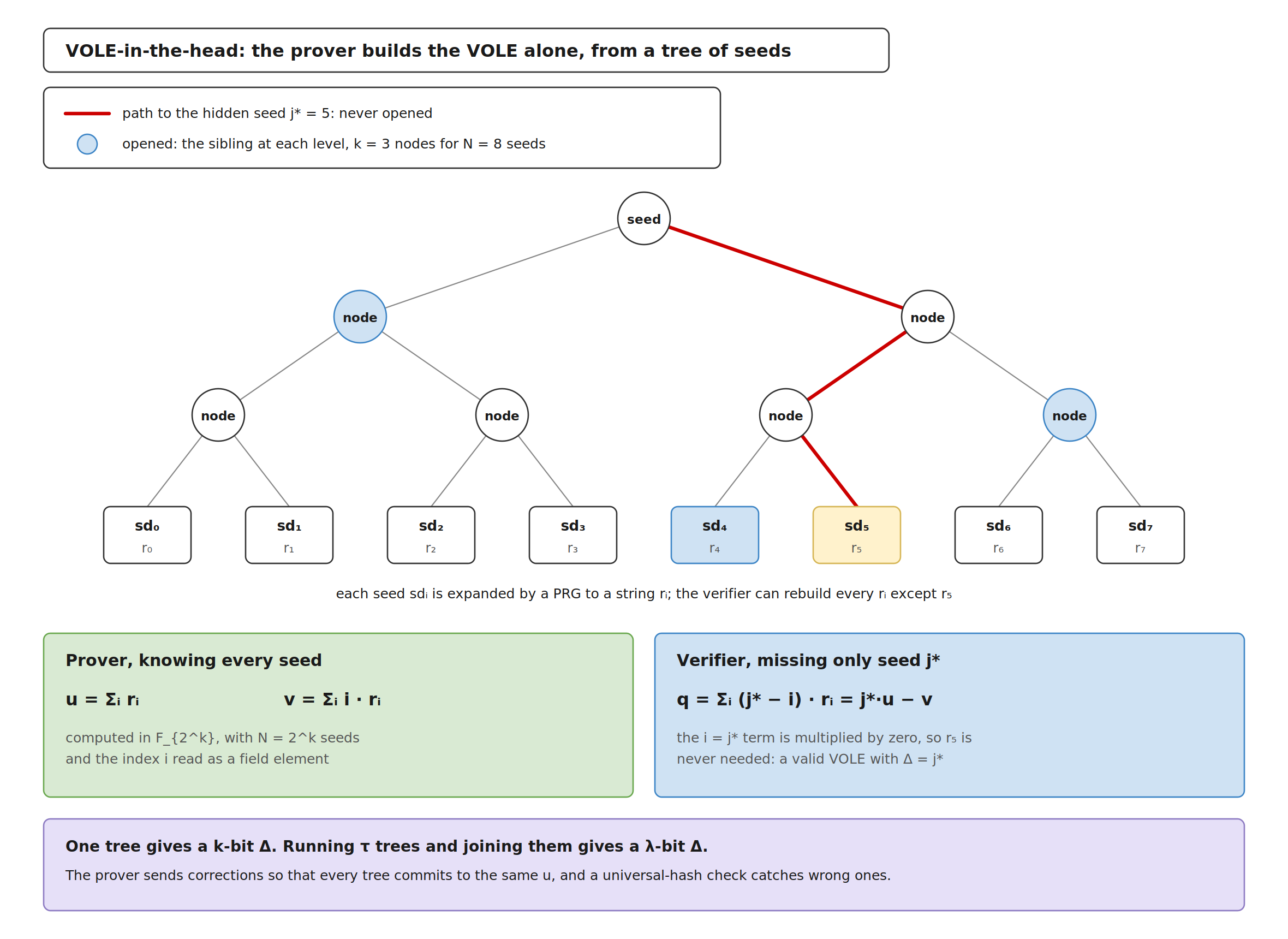
The order is essential: once the prover knows \(\Delta\), binding is gone. With Fiat–Shamir, every challenge is a hash of the transcript so far, and the proof becomes a non-interactive, publicly verifiable signature.
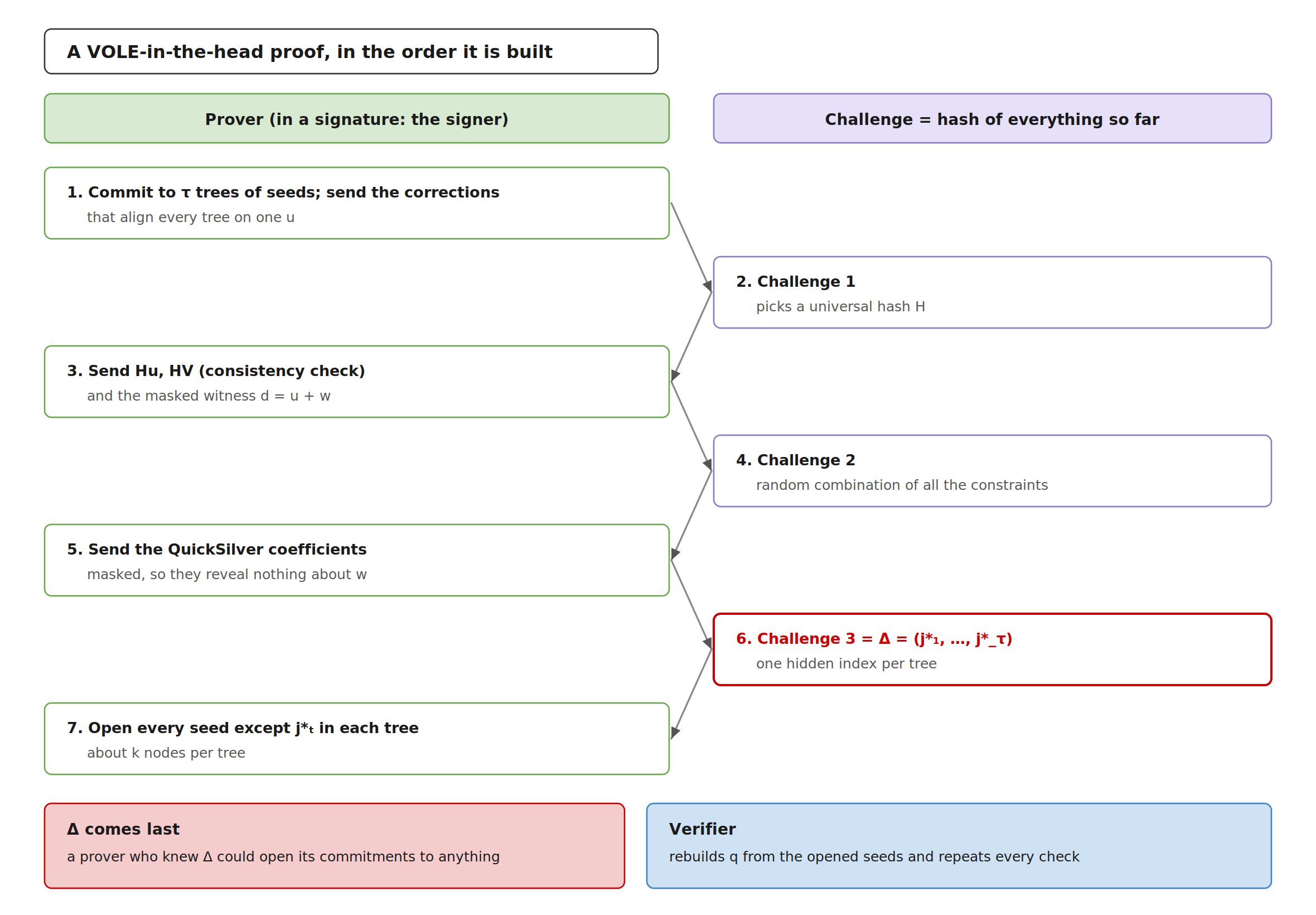
A single tree gives \(\Delta\) only \(k\) bits. VOLE-in-the-head therefore runs \(\tau\) trees and joins them into one \(\lambda\)-bit key.
- Aligning the trees. The prover sends corrections that make every tree commit to the same \(u\).
- Checking the corrections. A universal-hash consistency check, from Roy's SoftSpokenOT, catches a prover who sends wrong ones.
What a proof costs
A proof contains:
- the masked witness;
- \(\tau - 1\) correction vectors of the same length;
- the consistency-check and QuickSilver values;
- for each tree, the opened path and the commitment to the hidden seed.
Its size therefore grows linearly with the witness, and the number of constraints barely matters.
The parameter that trades size against speed is \(N\). A larger \(N\) needs fewer trees, which gives a shorter proof, but the prover and verifier expand about \(\tau \cdot N\) seeds, which makes it slower. FAEST names the two ends "s", slow and short, and "f", fast and long.
Compared with MPC-in-the-head
Both techniques begin by splitting the witness into \(N\) shares and hiding one.
- MPC-in-the-head (Ishai, Kushilevitz, Ostrovsky and Sahai, 2007) simulates a multi-party computation and opens all but one party's view. It is the basis of Picnic and of the round-3 candidate SDitH.
- VOLE-in-the-head replaces the multi-party computation with a two-party, VOLE-based proof, closer to oblivious-transfer extension.
Its authors report proofs that are linear in size and simpler, smaller and faster than MPC-in-the-head. The communication is about twice that of the best VOLE proofs that only a designated verifier can check.
FAEST, the signature built on it
A FAEST key pair is a plaintext–ciphertext pair \(\mathit{pk} = (x, y)\) with secret key \(k\) such that \(\mathrm{AES}_k(x) = y\). A signature is a VOLE-in-the-head proof of knowledge of \(k\), with the message bound into the Fiat–Shamir challenges.
- Witness. The prover records bits around each AES S-box and proves them consistent with low-degree constraints. FAEST v2 uses degree-3 constraints.
- FAEST-EM. This variant uses the Even–Mansour form \(y = \mathrm{AES}_x(k) \oplus k\), with \(x\) public, so there is no key schedule to prove.
- Assumptions. Apart from AES, FAEST's security rests only on PRGs and hash functions, because QuickSilver is information-theoretically secure. FAEST is also in NIST's third round.
| Parameter set | Public key | Signature |
|---|---|---|
| FAEST-128s | 32 B | 4,066 B |
| FAEST-128f | 32 B | 5,170 B |
| FAEST-EM-128s | 32 B | 3,466 B |
| FAEST-EM-128f | 32 B | 4,170 B |
The same machinery proves other one-way functions. KuMQuat (Baum, Beullens, Mukherjee, Orsini, Ramacher, Rechberger, Roy and Scholl, ePrint 2024/490) proves knowledge of a solution to an MQ system, and the Privacy Pass work proves knowledge of a UOV signature.
4. Why they fit together
To prove "I hold a valid UOV signature \(s\) on \(t\)", the prover commits to \(s\) and shows \(P(s) = t\).
| UOV signature (uov-Ip) | ML-DSA-44 signature | |
|---|---|---|
| What the proof checks | 45 quadratic equations in \(s\): \(P(s) = t\) | NTTs, SHAKE, rounding and norm bounds |
| Constraint degree | 2, which QuickSilver checks directly | mixed; the arithmetic is decomposed gate by gate |
| Witness | \(s\) alone: 119 elements of \(\mathbb{F}_{256}\), 952 bits | every intermediate value |
| Field | \(\mathbb{F}_{256}\), inside \(\mathbb{F}_{2^\lambda}\) as FAEST already uses it | the ML-DSA prime field, which is not binary |
The witness drives the proof size, and for UOV it is small. The 46.6 KB public key is an input that both sides already hold, so it costs computation but no proof bytes, and an issuer's key is fetched once and used for many tokens.
What remains expensive is hashing inside the proof. In PoMFRIT the client proves \(P(s) = H(m, r)\) with \(r\) secret, so \(H\) has to be evaluated in zero knowledge. That is why removing one hash, at the price of the one-more-UOV assumption, is the optimisation that matters.
5. The three constructions
PoMFRIT (Baum et al., USENIX Security 2026, ePrint 2026/109) turns a signature into a blind signature:
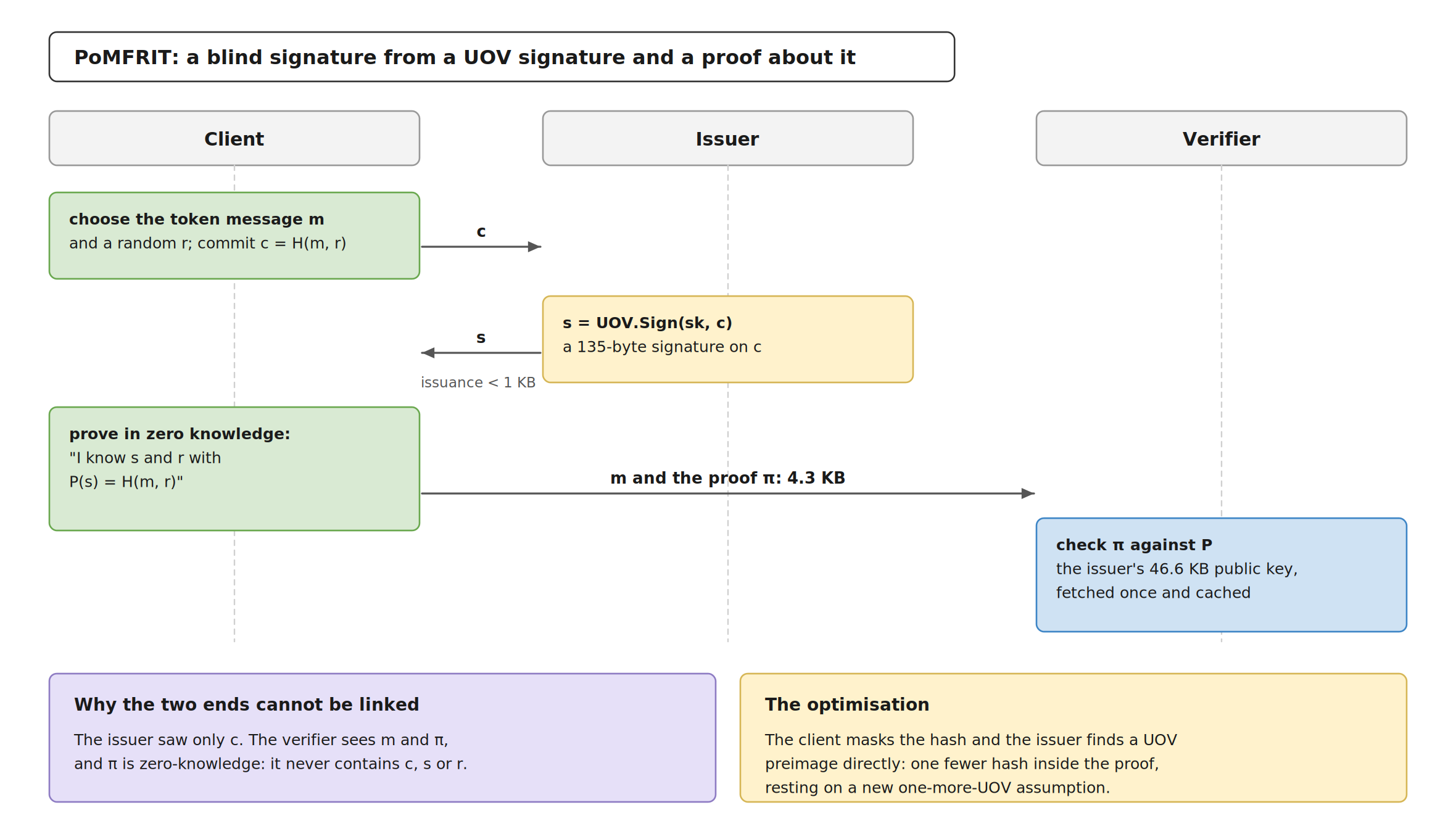
- The client commits to its message, \(c = H(m, r)\).
- The issuer signs the commitment, \(s = \mathrm{Sign}(\mathit{sk}, c)\).
- The client proves in zero knowledge that it knows \(s\) and \(r\) such that \(\mathrm{Verify}(\mathit{pk}, H(m, r)) = 1\). That proof is the blind signature.
The issuer saw only \(c\), and the verifier sees only a proof, so the two cannot be linked. The paper uses MAYO, for a 6.7 KB signature; with UOV it is 4.3 KB, and issuance stays under 1 KB. A further optimisation has the client mask the hash and the issuer find a UOV preimage directly, removing one hash from the proof; it changes the security assumption to one-more-UOV.
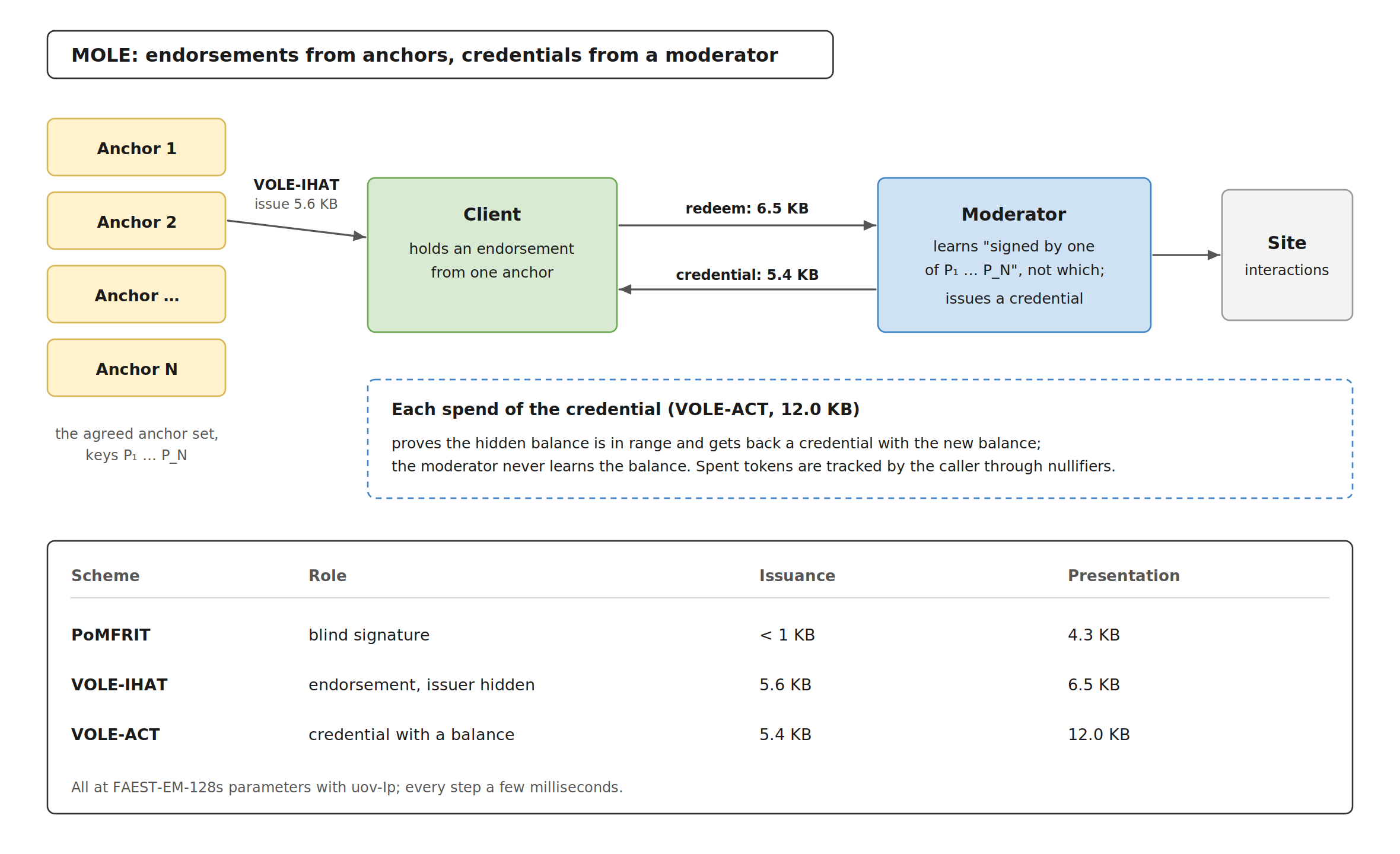
MOLE (Moderation Of unLinkable Endorsements) is the protocol shape the other two schemes target, which the post links to Mozilla Hacks. An anchor issues an endorsement; a moderator accepts its redemption, where the client proves it holds an endorsement from one key in the agreed anchor set without saying which; the moderator then issues a credential that governs the client's interaction with the site. Credentials need not hide their issuer or be publicly verifiable.
- VOLE-IHAT is the endorsement candidate: an issuer-hiding token whose redemption proves a valid signature under one of the anchor keys \(P_1, \dots, P_N\), with the index kept in the witness. 5.6 KB to issue, 6.5 KB to redeem.
- VOLE-ACT is the credential candidate: an anonymous credit token whose balance the issuer updates on each spend without learning it. Proving that a balance lies in a range is cheap in VOLE-in-the-head. 5.4 KB to issue, 12.0 KB to spend.
6. The code
cloudflareresearch/vole-mole is a C++ library built with Meson, under the BSD 3-Clause licence. It implements PoMFRIT, VOLE-IHAT (bound and unbound) and VOLE-ACT, with examples for each, and bundles faest-arch-opt (MIT) and pqov (CC0 or Apache-2.0).
- Build. Meson 1.4+, Ninja, Python 3 and Clang 21+ or GCC 16+.
- Performance, on an Apple M4 Pro by the README: client messages with proofs of 5–17 KB, or 4–12 KB with the smaller-proof parameter option; every step under 2 ms except VOLE-IHAT redemption, about 7 ms with 64 anchors.
- Status. "Experimental and not audited. Do not use in production." Double-spend checks belong to the caller, who tracks nullifiers.
7. The work the authors set out
The post closes by calling post-quantum anonymous credentials a move "from cryptography design to protocol engineering", and lists what comes next:
- security proofs that reduce each protocol to the security of UOV;
- more cryptanalysis of multivariate schemes, which may change parameters and costs, with NIST Level 3 parameters for UOV suggested as a hedge for the one-more-UOV optimisation;
- amortisation, so one redemption covers several requests.
What it means in practice
- Operators of Privacy Pass issuers. Today's tokens stay private after Q-day; forgery is the exposure, and it matters only once a quantum computer exists, since tokens are short-lived. That puts this migration on the signature clock, not the harvest-now-decrypt-later clock that drove key exchange.
- Protocol designers. A 4–12 KB token is workable on the web. Size, not compute, is the cost to plan for, and caching the 46.6 KB issuer key is part of the design.
- Implementers. Use
vole-moleto measure and to experiment. The authors list security proofs and stable parameters as the next step.
Sources
- Bas Westerbaan, The post-quantum future of web privacy, Cloudflare, 6 November 2026.
cloudflareresearch/vole-mole, README.- Baum et al., Publicly verifiable zero-knowledge and post-quantum signatures from VOLE-in-the-head, Crypto 2023.
- Baum et al., Concretely efficient blind signatures based on VOLE-in-the-head proofs and the MAYO trapdoor (PoMFRIT), USENIX Security 2026.
- Forging 1024-bit RSA signatures in nearly SNFS time, ePrint 2026/2131.
- Beullens, Chen, Ding, Gong, Kannwischer, Patarin, Peng, Schmidt, Shih, Tao and Yang, UOV: Unbalanced Oil and Vinegar, Algorithm Specifications, Version 3.0, 30 August 2026.
- The FAEST team, FAEST v2: Algorithm Specifications, Version 2.0, and the current parameter sets.
- Yang, Sarkar, Weng and Wang, QuickSilver: efficient and affordable zero-knowledge proofs for circuits and polynomials over any field, CCS 2021.
- Beullens, Breaking Rainbow takes a weekend on a laptop, Crypto 2022.
- Baum, Beullens, Mukherjee, Orsini, Ramacher, Rechberger, Roy and Scholl, One tree to rule them all: optimizing GGM trees and OWFs for post-quantum signatures (KuMQuat).
- MAYO parameters; NIST IR 8610, the third round of additional signatures.
- IETF Privacy Pass working group.